
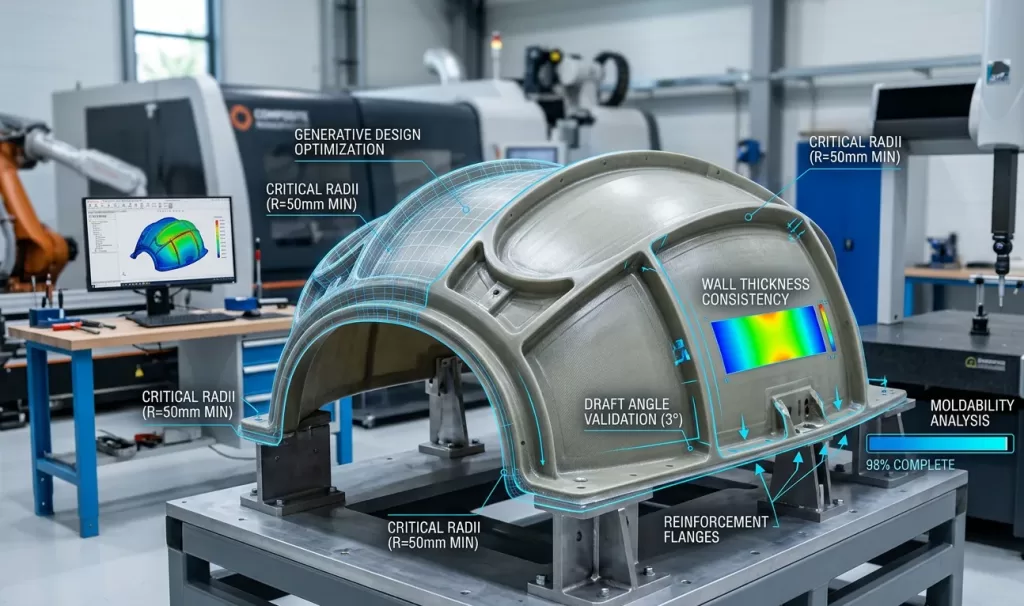
For many organizations, the transition from metal assemblies to high-performance composites like carbon fiber or fiberglass is driven by weight and strength requirements. However, the most successful projects aren’t just “converted” from metal—they are **Designed for Manufacturing (DfM)** specifically for composites.
At Laminate Engineering, we often see designs that are mathematically perfect in CAD but financially disastrous in the cleanroom. This handbook outlines the critical technical pillars of composite DfM to help Senior Engineers and Procurement Managers optimize for both performance and budget.
1. The Geometry of Separation: Why Draft Angles Matter
In metal machining, a 0° vertical wall is standard. In composite molding, it is a “cost-killer.”
The Technical Reality: A part with a 1° to 3° draft angle only needs to separate from the mold surface for a fraction of an inch before it slides out freely. Without draft, you are fighting friction over every inch of the part’s depth.
The “Stuck Mold” Case Study: We once processed a part where the customer insisted on 0° draft for assembly fit. Demolding became a mechanical battle. We eventually had to drill into the back of the mold to use pressurized air to “pop” the part loose. The result? The mold required expensive repairs every 2-3 cycles, adding significant overhead to the unit cost.
Recommendation: Aim for 3°+ for the “Gold Standard.” Never go below 1° unless the assembly absolutely demands it.
2. Radii and Fillets: Avoiding Structural Liabilities
In the world of composites, “more material” does not always mean “more strength.” When a design features sharp internal corners, resin tends to pool in those gaps, creating “resin-rich” areas.
Why Resin-Rich is Bad: Resin is brittle and carries load poorly compared to reinforced fibers. These pockets are prone to cracking—sometimes as early as the demolding process—and act as stress concentrators during the part’s lifecycle.
Recommendation: Maintain an inside radius of >0.250″ whenever possible to ensure proper fiber consolidation and avoid air pockets.
3. The Tolerance Trap: Component vs. Assembly
Engineers often apply tight tolerances (+/- 0.005″ or less) to every component, fearing a “tolerance stack-up” at assembly. In composites, as-molded precision at that level is incredibly expensive.
The Better Approach: Allow for looser, more realistic “as-molded” tolerances (e.g., +/- 0.030″). Handle the precision requirements at the assembly level through techniques like **match drilling**. This ensures the final fit is perfect without driving the cost of every individual component into the stratosphere.
4. Moving Beyond “Metal-Think”
Many designers coming from a CNC or metal background include features that are easy to cut but nearly impossible to laminate.
- Design for Lamination: Geometry should support a logical, ply-by-ply layup. Features that interrupt the flow of continuous fibers weaken the structure.
- Fiber Continuity: Specifying a woven material on a very thin strip is a common mistake. If the strip is too narrow, you lose the continuous fiber reinforcement that gives the material its strength.
- The Exotherm Risk: Thick, solid composite sections are prone to *exotherm*—a thermal runaway during the curing process. To gain stiffness without the mass (and risk) of thick resin, we recommend using a **core material** (like foam or honeycomb).
5. The DfM Cheat Sheet
For quick reference, use the following table to categorize your design features.
| Feature | The “Gold Standard” | The “Cost Driver” | The “Manufacturer’s Nightmare” |
|---|---|---|---|
| Draft Angle | 3°+ | 1° | 0° (Vertical) |
| Inside Radius | > 0.250″ | 0.062″ – 0.125″ | Sharp Corner / Knife Edge |
| Tolerances | +/- 0.030″ (Molded) | +/- 0.005″ (Post-Machined) | +/- 0.002″ (As-Molded) |
| Surface Finish | Class A (One Side) | Class A (Both Sides) | High Gloss / Texture Match |
Partnering Early
The best way to avoid the “Manufacturer’s Nightmare” is to involve your composite partner early in the development cycle. At Laminate Engineering, we provide DfM audits during the geometry and material selection phases, before designs are locked in, to ensure your project is optimized for performance, schedule, and profit.
