
The Composite Recipe: Why Your Product Development Needs a Materials Matrix, Not Just a CAD Model
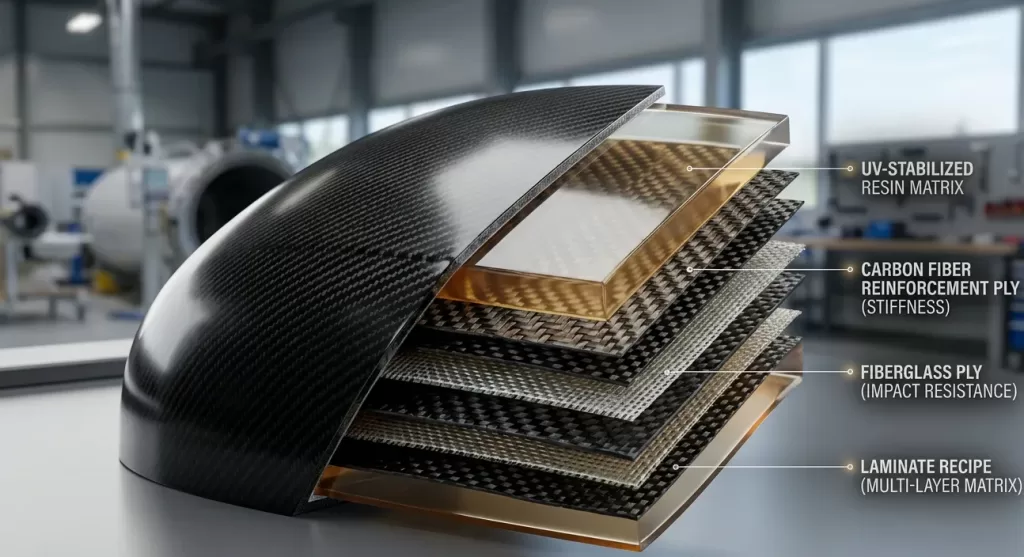
In B2B product development, there is a common but expensive misconception: that if you get the shape right in CAD, the material is just a secondary “fill” choice.
At Laminate Engineering, we look at it differently. We view product development as a **recipe**. If you’re building a high-performance part, the “shape” is the plate, but the matrix, the specific combination of resins and reinforcements, is the meal. If the recipe is wrong, the product fails, regardless of how good the geometry looks.
Beyond “Just Fiberglass”
For engineers moving into composites, the choice often feels binary: “Cheap” Fiberglass or “Expensive” Carbon Fiber. But the real engineering happens in the gray area between those two.
Selecting the right reinforcement is about matching the environment to the performance requirement:
- Carbon Fiber: When stiffness-to-weight is the absolute priority.
- FRP (Fiberglass Reinforced Plastic): When durability, impact resistance, or cost-effectiveness are the primary drivers.
The “Secret” is in the Resin
While the fibers provide the strength, the resin system provides the protection. This is where most field failures originate. If you wait until the prototyping phase to think about the environment, you’ve already lost.
We guide our clients to select their resin based on the “Worst Day” the product will face:
- 1. UV Exposure: Will the part yellow or become brittle in the desert sun? You need a UV-stabilized matrix from day one.
- 2. Fire Safety: Does the part need to meet ASTM or UL fire-retardant standards? Choosing a fire-retardant (FR) resin changes the layup, the weight, and the cure cycle.
- 3. Chemical Resistance: Will this be exposed to hydraulic fluid, salt spray, or industrial cleaners? A general-purpose polyester resin will delaminate where a Vinyl Ester or specialty Epoxy would thrive.
Preventing Costly Failures
The “Recipe” approach prevents the most painful type of engineering failure: the Late-Stage Reality Check.
It is common to see a part that works perfectly as a prototype, only to fail in the field because the “general purpose” material couldn’t handle the actual operating environment. Moving these material decisions to the development phase isn’t just “good engineering”—it’s risk management.
The Takeaway:
Don’t just design a shape. Design a matrix. If you know your product needs a composite solution but you aren’t sure which specific recipe of resin and reinforcement is right for your environment, that is where our engineering team starts.
Laminate Engineering specializes in design-build composites for industrial, aerospace, and commercial applications. We don’t just build to print; we help you write the recipe.
