
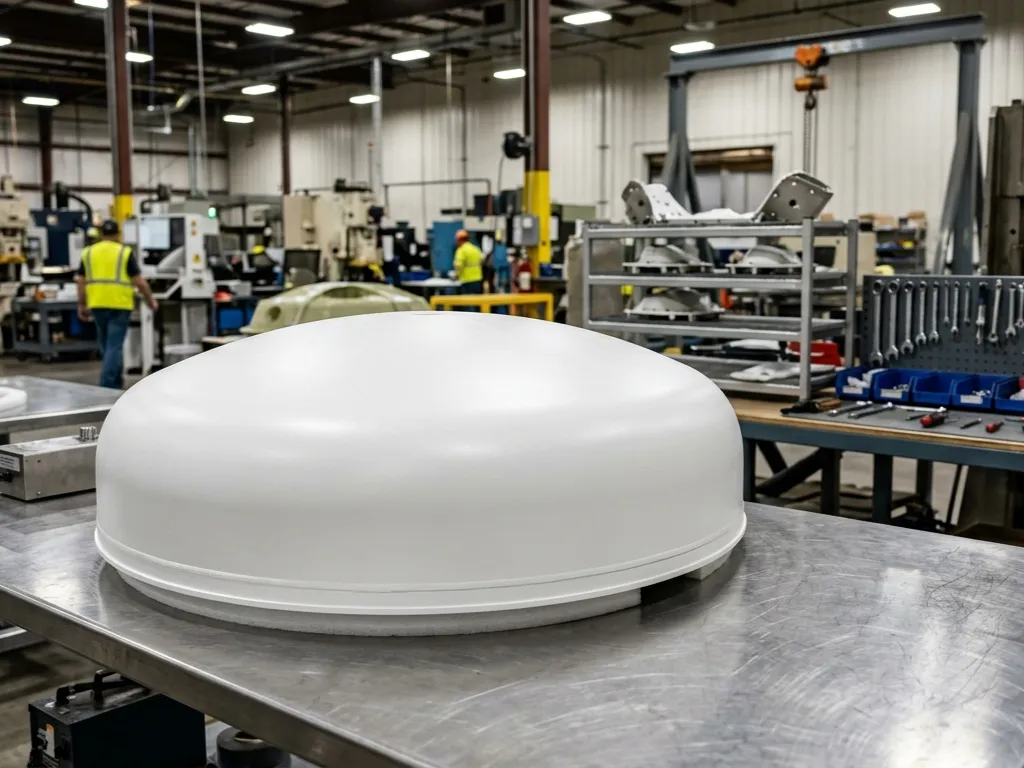
In the world of composite radomes, what works on a computer screen often fails in the layup mold—or at the very least, costs twice as much to build as it should.
For mid-sized firms looking to solve frequency requirements, the standard approach is often fragmented: hire a design consultant for Electromagnetic (EM) modeling, then find a “build-to-print” composite shop to manufacture the part. At Laminate Engineering, we’ve found that this siloed approach creates two critical vulnerabilities.
1. The Material Reality Gap
Most EM models assume a mathematically perfect composite structure. In reality, raw material properties vary, and even minor manufacturing defects—resin-rich areas, fiber misalignment, or non-uniformities—can alter material properties and RF performance.
When design and manufacturing are separate, the designer doesn’t always account for these “shop-floor” realities, and the manufacturer doesn’t have the context to know how a deviation in the layup affects the final signal.
2. The Cost of Over-Engineering
A design can be technically perfect from an RF perspective but a nightmare for manufacturability. If a design doesn’t account for common composite processing methods, it can drive costs well beyond the project budget.
By integrating design and manufacturing in-house, we apply Design for Manufacturability (DFM) principles from day one. We aren’t just designing a radome that works; we’re designing a radome that is efficient to build.
Case Study: Solving Obsolescence and Reducing Costs
Recently, we helped a customer navigate the challenge of antiquated, obsolete materials in an old radome specification. By leveraging our dual design-build capability, we:
- Identified modern, readily available material alternatives.
- Verified their performance through modeling.
- Selected materials that were easier to process, significantly reducing total production costs.
The Laminate Engineering Advantage
Working with a single-source partner simplifies your supplier management and ensures your design is grounded in manufacturing reality. If you have a frequency requirement but don’t want to manage the friction between a consultant and a shop, we’re the missing link.
Ready to bridge the design-build gap? Contact us today to discuss your next composite project.
