
Beyond Plastic: Why FRP is the New Standard for Industrial Infrastructure
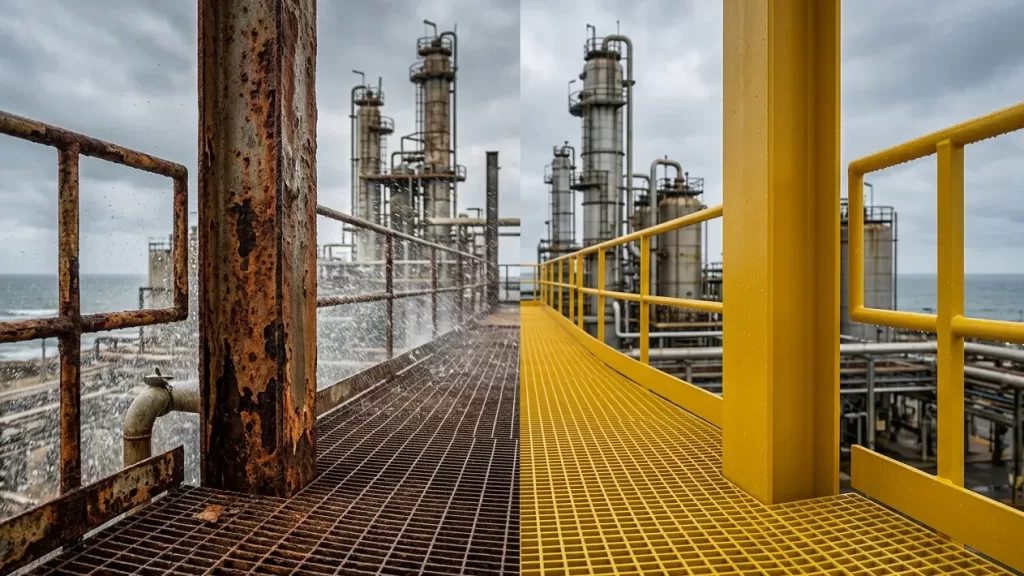
In the world of industrial infrastructure, there is a persistent myth that fiberglass-reinforced polymer (FRP) is “just plastic”—a lightweight substitute that cannot match the ruggedness of steel or the permanence of concrete. However, for engineers managing chemical plants, wastewater facilities, or coastal installations, the reality is shifting. As traditional materials succumb to corrosion and environmental fatigue, FRP is emerging as the superior choice for long-term durability.
The Freeze-Thaw Advantage
One of the most common applications we handle at Laminate Engineering is the production of FRP walkways. While concrete is often the default choice for these structures, it carries a fundamental weakness: porosity. In environments with fluctuating temperatures, water seeps into concrete pores and seams. When that water freezes, it expands, causing micro-cracks that eventually lead to structural failure. FRP, by contrast, is non-porous and resilient. It does not crack under freezing cycles, ensuring a walkway that remains safe and intact long after concrete has begun to crumble.
Unmatched Logistics and Installation Efficiency
The transition from steel to FRP also yields massive savings in project logistics. An FRP walkway can weigh between 80% and 90% less than a comparable steel or concrete structure. This weight reduction translates directly to the bottom line in two ways:
- Shipping Costs: Moving heavy concrete slabs or steel beams is an expensive, logistical hurdle. FRP components can often be shipped in larger sections at a fraction of the cost.
- Labor and Equipment: Installing traditional materials typically requires specialized heavy machinery and large crews. Because FRP is so lightweight, installation labor is significantly reduced, and most components can be maneuvered without the need for heavy cranes or expensive equipment rentals.
The Aesthetic and Structural Power of Seamless Design
Beyond the functional benefits, composites allow for design freedom that traditional materials simply cannot offer. In a recent project, we replaced a sectional concrete walkway with a single-piece FRP solution. By eliminating the seams required for concrete pouring, we provided a sleek, continuous aesthetic that the client desired. More importantly, removing those seams eliminated the joints where debris and moisture typically collect, further extending the lifecycle of the installation.
For industrial leaders looking to reduce maintenance overhead and improve installation speed, FRP isn’t just a plastic alternative—it is the engineering evolution of industrial infrastructure.
